




 | 아로마 | |||||||||||||||||||||||||||||||||||||||||||||||||||||||||
|---|---|---|---|---|---|---|---|---|---|---|---|---|---|---|---|---|---|---|---|---|---|---|---|---|---|---|---|---|---|---|---|---|---|---|---|---|---|---|---|---|---|---|---|---|---|---|---|---|---|---|---|---|---|---|---|---|---|---|
 | 18강. 부사 3 1. 강조 부사 just, right ◆ just/right(바로)는 before나 after를 앞에서 강조한다.
Please have my car ready just(=right)before I have to leave. ◆ just enough 겨우, 간신히 Sarah had just enough money to buy herself dinner. 2. only, just ◆ only/just(오직, 단지)는 전치사구나 명사구를 강조한다. Employees may wear casual attire only on Fridays. There will be just a brief delay while we test the equipment. only/just+숫자⇒ 겨우 ex)only 5 dollars⇒ 겨우 5달러 3. well ◆ well(훨씬)은 전치사구를 강조한다. The final cost of the renovations was well under the original estimate. well in advance/well ahead of time⇒ 훨씬 이전에
4. even ◆ even(~조차도, ~까지도)은 단어나 구를 앞에서 강조한다.
5. quite ◆ quite(굉장한)는 ‘a/an+명사’를 앞에서 강조한다. → quite+a/an+명사 The singer’s nightly concert was quite an accomplishment. quite a view!!! 정말 멋진 전망이군!! ◆ not~quite→ 꼭 ~인 것은 아니다. I am not quite able to accept the situation. ◆ quite+형/부=quite/pretty/fairly surprising ※ a little〈quite/pretty/fairly 〈very 6. 원급/비교급/최상급 수식 부사
This resort is just as luxurious as the one further up the beach.[원급] Aron’s proposal was much better than Steve’s.[비교급] Seron is by far the largest steel producer in the country.[최상급] 7. so, such, very, too
The salary is too low for Mr. Anderson to accept the position. ※ too much VS much too → too much+불가산 명사 ex) too much money → much too+형용사/부사 ex) much too expensive ☺ ‘too much’와 ‘much too’는 표면상으로는 순서만 바뀌어 있는데 실질적인 뜻은 어떻게 다른지 전혀 몰랐어요. 그런데 마침 이번 강의에서 이 두 가지 표현에 대해서 다뤄서 잘됐다싶었어요. ‘too much’ 뒤에는 불가산명사가 오고 ‘much too’ 뒤에는 형용사나 부사가 오는데, 그 이유를 강사님이 정확하게 설명해주셨어요. ‘too much’의 ‘much’는 형용사이기 때문에 뒤에 불가산 명사가 오는 것이고 ‘much too’의 ‘too’는 부사이기 때문에 뒤에 형용사나 부사가 오는 것이에요. 두 표현이 사용된 예문을 암기해두면 문제를 풀 때 답을 빨리 골라낼 수 있어요. The subway was [so/such/very/too] crowded this morning that I could hardly move. The movie was [so/such/very/too] an excellent film that I watched it several times. The receptionist was [very/too] busy to go for lunch. 8. also/too/as well/either
The firm has offices in New York, Vancouver, and also London. The accounting manager will attend the conference too /as well. Steven won’t be working on Saturday. Sarah won’t be working either. My sister likes this movie. → I like this movie, (also, too, as well, either). → I (also, too, as well, either) like it. My sister doesn’t like this movie. → Me (also, too, as well, either). 9. later/thereafter/since ◆ later(이후에)/thereafter(그 이후에)
☺ ‘later’와 ‘thereafter’는 둘 다 ‘~이후에’라는 의미의 부사라는 것은 알고 있는데, 어떨 땐 ‘later’를 사용하고, 어떨 땐 ‘thereafter’를 사용하는지 몰랐어요. 그런데 이번 강의를 통해서 두 부사의 차이점에 대해서 확실히 알게 되었어요. 두 부사가 사용된 예문을 보니 금방 차이점을 알겠더라구요. 예문을 보면서 저 나름대로 이해한 것은 ‘later’는 주로 ‘later’의 앞이나 뒤에 ‘week’나 ‘month’와 같은 시간관련 표현이 온다는 것이고, ‘thereafter’는 어떤 행동 뒤에 온다는 것이에요. 두 부사에는 이러한 미묘한 차이가 있으니 마음내키는 대로 아무 부사나 쓰면 안 되겠어요. ◆ since(그 이래로) -since(접접전부)- 완료 시제와 함께 사용
Fiona finished university and has since been employed by a publishing company. 10. forward/ahead, backward/behind
The repairman leaned (ahead, forward) to examine the machine. 앞쪽으로 In the months (forward, ahead), employees will have to work extra hours. 여러 달 남아 있는 상태 I looked at the car ahead. 나는 앞에 있는 차를 보았다. ☺ ‘forward/ahead’, ‘backward/behind’는 정말 헷갈리는 단어세트예요. ‘forward’와 ‘ahead’는 둘 다 ‘앞에’라는 뜻의 부사인데 사용되는 경우가 달라요. 강사님이 들어주신 예문을 보니 두 부사의 차이점을 확실히 이해할 수 있었어요. 예문을 보기 전에 그냥 말로만 ‘forward’는 ‘앞을 향해서’라는 뜻이고, ‘ahead’는 ‘앞에’라는 뜻이라는 설명을 들었을 때는 정확히 어떤 차이가 있는지 몰랐거든요. 예문을 보면서 제가 나름대로 내린 결론은 ‘forward’는 물리적인 앞이고, ‘ahead’는 추상적인 앞이라는 것이에요. ‘backward’와 ‘behind’도 둘 다 ‘뒤에’라는 뜻의 부사이지만 ‘forward’와 ‘ahead’처럼 ‘backward’는 물리적인 뒤이고, ‘behind’는 추상적인 뒤예요. ‘backward’와 ‘behind’도 ‘forward’와 ‘ahead’처럼 구체적인 예문을 제시해주셨더라면 좋았을 텐데 그러지 않으셔서 안타까워요. 강의에서는 예문을 못 봤지만 인터넷 검색을 통해서 제가 직접 예문을 찾아봐야겠어요.
★ 18강 추가자료- 부사
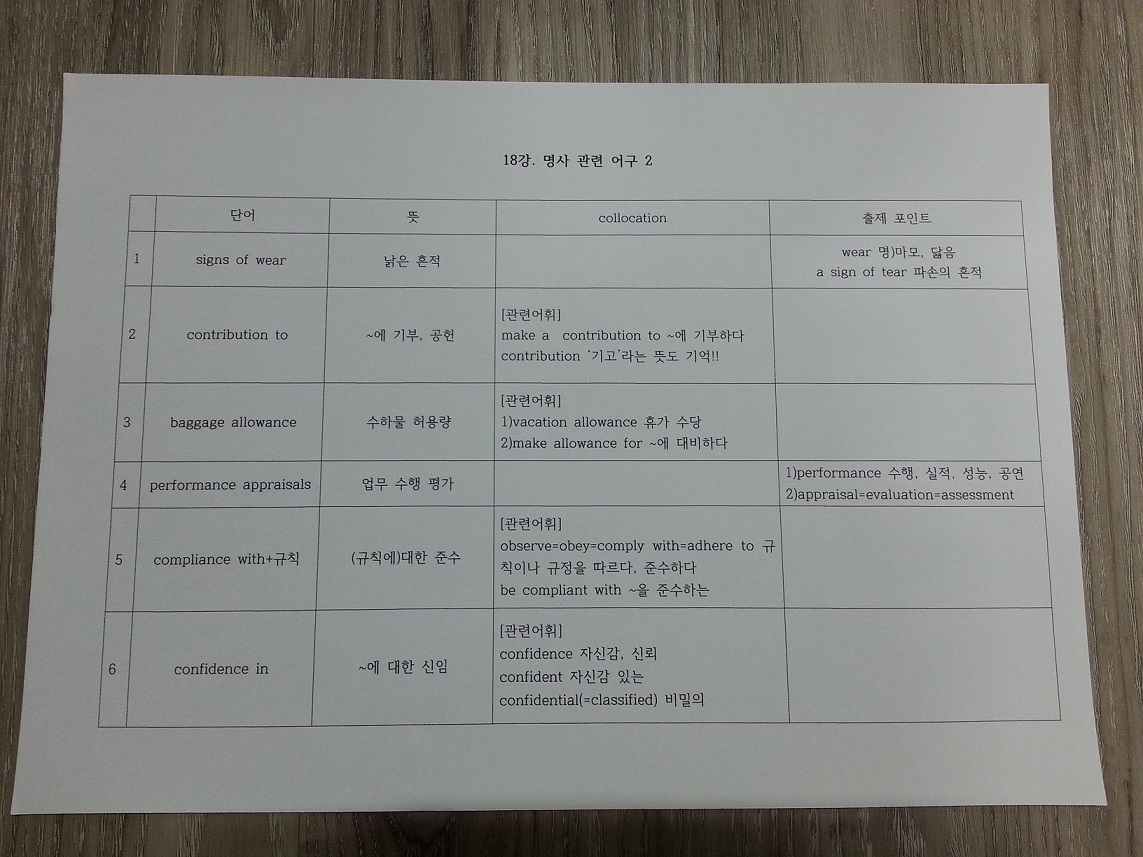
★ 어휘- 명사 관련어구 2(18강에서 배운 어휘를 표로 정리한 것)
| |||||||||||||||||||||||||||||||||||||||||||||||||||||||||









 0
0


