



명사절 접속사: 의문사
*의문대명사(who/whose/what/which)->불완전. 주어,목적어,보어가 없는 불완전한 문장
What she mentioned was interesting. 목적어 역할
I can’t decide which is the best. 주어 역할
*의문형용사(what/which/whose)->불완전
[의문형용사+명사]가 문장에서 주어,목적어,보어
I wasn’t told whose plan it was.[보어]
What price you paid is irrelevant.[목적어]
*의문부사(when/where/how/why)->완벽한 절
I will notify you when the repairs will be finished.
Where you should be indicated on the form.
*명사절 의문사+to부정사
->의문사+주어+should+동사
I can’t choose what to read(=what I should read)first.
___N+to부정사->의문형용사
I don’t know(what,which,whose)car to buy.
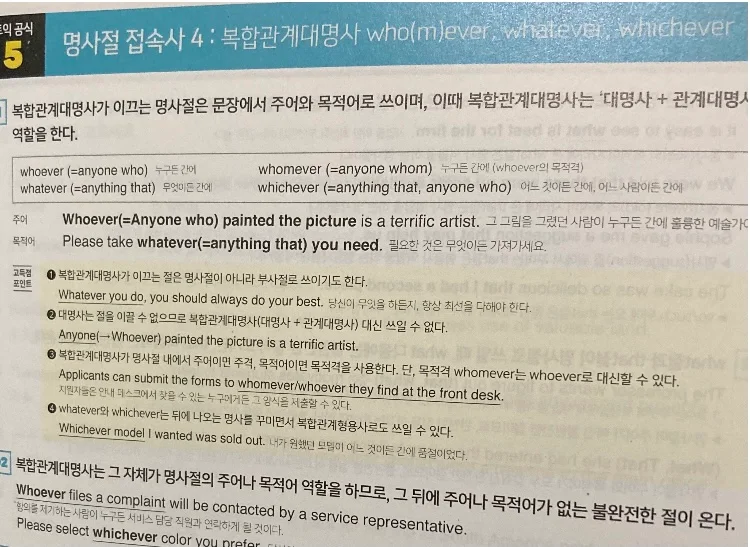
*복합관계대명사=대명사+관계대명사의 성질. 선행사가 포함되어 있다.
불완전->명사절(부사절)
*복힙관계대명사는 대명사+접속사의 역할
Whoever(=anyone who)painted the picture is a terrific artist.
*복합관계대명사의 명사절 vs 부사절
Whoever answers the phone should be polite. 명사절
Whoever answers the phone they should be polite. 부사절
*복합관계대명사 다음에는 불완전한 문장이 온다.
*복합관계사를 쓸지 의문사를 쓸지는 문맥에 따라 결정한다. Who 누가 Whoever 누구든지 간에
*what과 that의 구별
The professor wants to figure out what motivates students to learn.불완전
That she had entered the wrong building was apparent. 완전
핵심단어
attached 첨부된, 부가적으로 붙은
connected 연결된
early 조기의, (시간상)이른
previous (시간상)이전의
extensive 광범위한, 포괄적인
spacious (장소가)넓은
outstanding 뛰어난, 눈에 띄는, 미결제된
evident 명백한

 2
2


